

Início Site

Mastercard launches Agent Pay for Machines to offer high-speed payments available 24 hours a day.

The emergence of AI has created new ways to buy and sell goods and services. Now, it is demanding a new class of payments. Mastercard envisions a future where companies create services so that AI agents can make purchases. Operating at machine speed, these agents could transact with each other continuously at high speed, executing chains of transactions, including microtransactions. This shift could unleash a new massive wave of innovation, business models, and economic activity, where any company, from individual entrepreneurs to the largest corporations, can become a virtual powerhouse.

To enable this new form of commerce, Mastercard has developed a new way to pay for these services: payments, even if they are just cents, to be completed quickly, programmatically, and securely. The company introduces the Agent Pay for Machines (AP4M), a new service that will allow these transactions to be authorised, orchestrated, and settled at machine speed across its global payment network.

“The ‘Agent Pay for Machines’ will create the conditions for an explosion of AI business models,” stated Jorn Lambert, Chief Product Officer at Mastercard. “Machine-to-machine payments can enable the buying and selling of services between agents on fundamentally different scales than current payments — very high volumes, very low values, with great speed and extremely low latency.”

Unlike traditional payments at points of sale or between people and merchants, which are one-off and user-initiated, these transactions are programmatic, always active, and executed between systems behind the scenes of digital commerce. The Agent Pay for Machines allows Mastercard network participants to bring the trust and controls of the company’s global network to machine-driven commerce, helping AI innovators enable secure and reliable payments as the software can perform transactions autonomously.

Building a new class of payments

AI agents are no longer just assisting in decisions. They are capable of acting according to human intent, coordinating services, and completing customised transactions for their users. An entrepreneur opening a flower shop could instruct an AI agent to build and launch the store’s online presence, purchasing a domain name, a hosting service, images, and checkout pages within a defined budget, transforming a single request initiated by a human into a chain of transactions automatically executed between providers.

In another example, a logistics agent managing a delivery route could pay for shipping, book access to the unloading platform, purchase temporary tracking data for the chain, and settle handling fees at the warehouse automatically as a shipment moves from origin to destination.

Payments are not just increasing. They are changing shape. They become continuous, embedded, authorised, and executed at machine speed. This creates a new requirement: an infrastructure capable of keeping pace with this movement.

In this new environment, businesses seek the peace of mind of the assurance that they will receive payment. Agents need transactions to move instantaneously, with each transaction completed securely and as expected. The Mastercard Agent Pay for Machines has been designed to meet these needs.

The service is built on the Mastercard Agent Pay program, introduced in 2025, providing a system to scale high-frequency, low-latency, low-value payments executed by agents and machines. While Agent Pay defines how trusted AI agents participate in payments, Agent Pay for Machines is designed for a complementary opportunity: automated, micro, machine-driven transactions that happen continuously in the background of digital commerce.

This is where the Mastercard global network plays a critical role. The Mastercard Agent Pay for Machines supports credentialing, controls, and guaranteed settlement across multiple payment types, from cards to stablecoins, enabling organisations to deploy automated payments with the interoperability, reliability, and governance that the digital economy demands.

How it works

The Mastercard Agent Pay for Machines establishes a trusted system for machine-driven transactions through a set of core capabilities:

· Credentialing: Each agent is credentialed and, with Verifiable Intent, can be recognised and transact confidently across ecosystems.

· Authorisation: Organisations can set authorisation rules and spending limits that are applied programmatically, ensuring that transactions remain within the defined parameters.

· Transaction: Verified participants can connect and transact between providers and systems, enabling continuous automated and high-frequency commerce.

· Settlement: Supports reliable and guaranteed multi-rail settlement across cards, accounts, and stablecoins.

Transactions occur predictably, enhancing transparency and consistency.

Partnering to scale an open ecosystem

Mastercard is collaborating with many partners to validate priority use cases, establish common rules, and accelerate adoption across industries. Initial participants and supporters include: Aave Labs, Adyen, Alchemy, Anchorage Digital, Ant International, Basis Theory, BVNK, Catena, Checkout.com, Cloudflare, Coinbase, Coinflow, Crossmint, Getnet from Santander, Global Payments, Lovable, Mastercard Merchant Cloud, MoonPay, Nevermined, OKX, PayOS, Polygon, Rain, Ripple, Sapiom, Skyfire, Solana Foundation, Stripe, t54 Labs, Tempo, Turnkey, and Utila.

Supporting the next phase of digital commerce

The Mastercard Agent Pay for Machines expands Mastercard’s efforts to enable trusted digital interactions, from identity and authentication to reliable data exchange, so that companies can adopt new technologies without compromising the security, reliability, and reach they expect from Mastercard’s global network. Alongside Agent Pay and Verifiable Intent, the Mastercard Agent Pay for Machines reflects Mastercard’s ongoing investment in building an open and reliable infrastructure for autonomous payments, driven by agents and powered by machines.

Brazil brings innovation with local partners in Agent Pay

In Brazil, Mastercard has been strengthening strategic partnerships to drive agent-based commerce with Agent Pay, involving the participation of local issuers and processors such as Itaú and Santander. These institutions have already conducted live transactions using Mastercard’s infrastructure, demonstrating the viability of AI agent-initiated payments at scale and with total security. The operations have involved real purchases across different segments, reinforcing the role of the Brazilian market as a leader in adopting innovative payment solutions and solidifying the region as fertile ground for the advancement of AI-driven commerce.

To learn more about the Mastercard Agent Pay for Machines, visit Link.
What is an Online Marketplace?

An online marketplace is a digital platform that connects buyers and sellers, allowing them to conduct business transactions over the internet. These platforms act as intermediaries, providing infrastructure for individual sellers or businesses to offer their products or services to a large number of potential customers. Some popular examples of online marketplaces include Amazon, eBay, Mercado Livre, and Airbnb.

History:

Online marketplaces emerged in the late 1990s with the advent of e-commerce. One of the first and most successful examples was eBay, founded in 1995, which started as an online auction site for consumers to sell items to one another. As the internet became more accessible and trust in e-commerce grew, more marketplaces emerged, covering a wide range of sectors and business models.

Types of online marketplaces:

There are several types of online marketplaces, each with its own characteristics and target audiences:

1. Horizontal marketplaces: Offer a wide variety of products from different categories, such as Amazon and Mercado Livre.

2. Vertical marketplaces: Focus on a specific niche or sector, such as Etsy for handmade and vintage products, or Zalando for fashion.

3. Service marketplaces: Connect service providers to clients, such as Fiverr for freelancers or Uber for transport services.

4. P2P (peer-to-peer) marketplaces: Allow consumers to sell products or services directly to one another, such as eBay or Airbnb.

Advantages:

Online marketplaces offer several advantages for sellers and buyers:

1. Expanded reach: Sellers can access a much larger audience than would be possible with a physical store.

2. Convenience: Buyers can easily find and purchase products or services at any time and from anywhere.

3. Variety: Marketplaces typically offer a large selection of products or services, allowing buyers to find exactly what they are looking for.

4. Trust: Established platforms provide reputation systems and consumer protection, increasing confidence in transactions.

5. Reduced costs: Sellers can save on operational costs such as physical space rent and staffing.

Challenges:

Despite their advantages, online marketplaces also present some challenges:

1. Competition: With many sellers offering similar products, it can be difficult to stand out and attract customers.

2. Fees: Platforms often charge fees on sales, which can reduce sellers’ profit margins.

3. Platform dependency: Sellers may become overly reliant on the marketplace, limiting their ability to build their own brand.

4. Quality issues: Ensuring the quality and authenticity of products can be a challenge, especially in marketplaces with many sellers.

Future of online marketplaces:

As e-commerce continues to grow, online marketplaces are expected to become even more prevalent and sophisticated. Some trends that are likely to shape the future of marketplaces include:

1. Personalisation: The use of data and artificial intelligence to provide more personalised shopping experiences.

2. Omnichannel integration: The combination of online and offline experiences to create a seamless shopping journey.

3. Specialised marketplaces: The emergence of more marketplaces focused on specific niches or communities.

4. Globalisation: The expansion of marketplaces into new international markets, connecting sellers and buyers around the world.

Conclusion:

Online marketplaces have revolutionised the way we buy and sell products and services, offering unprecedented convenience, variety, and accessibility. As technology advances and consumer habits evolve, marketplaces are expected to continue playing a central role in e-commerce and the global economy. Although there are challenges to face, the future of online marketplaces looks promising, with new innovations and opportunities continually emerging.

What is e-commerce?

E-commerce, also known as electronic commerce, is the practice of conducting commercial transactions over the internet. This includes the buying and selling of products, services, and information online. E-commerce has revolutionised the way businesses operate and how consumers acquire goods and services.

History:

E-commerce began to gain popularity in the 1990s with the advent of the World Wide Web. Initially, online transactions were largely limited to the sale of books, CDs, and software. Over time, as technology advanced and consumer confidence in e-commerce grew, more companies began to offer a wide range of products and services online.

Types of e-commerce:

There are several types of e-commerce, including:

1. Business-to-Consumer (B2C): Involves the sale of products or services directly to end consumers.

2. Business-to-Business (B2B): Occurs when one business sells products or services to another business.

3. Consumer-to-Consumer (C2C): Allows consumers to sell products or services directly to each other, usually through online platforms like eBay or OLX.

4. Consumer-to-Business (C2B): Involves consumers offering products or services to businesses, such as freelancers providing their services via platforms like Fiverr or 99Freelas.

Advantages:

E-commerce offers various advantages for businesses and consumers, such as:

1. Convenience: Consumers can purchase products or services at any time and from anywhere, as long as they have internet access.

2. Wide variety: Online stores often offer a much broader selection of products than physical stores.

3. Price comparison: Consumers can easily compare prices from different suppliers to find the best deals.

4. Reduced costs: Companies can save on operational costs, such as rent for physical space and staff, by selling online.

5. Global reach: E-commerce allows businesses to reach a much wider audience than would be possible with a physical store.

Challenges:

Despite its many advantages, e-commerce also presents some challenges, including:

1. Security: Protecting consumers’ financial and personal data is a constant concern in e-commerce.

2. Logistics: Ensuring that products are delivered quickly, efficiently, and reliably can be a challenge, especially for smaller businesses.

3. Intense competition: With so many companies selling online, it can be difficult to stand out and attract customers.

4. Trust issues: Some consumers still hesitate to shop online due to concerns about fraud and the inability to see and touch products before purchasing them.

Future of e-commerce:

As technology continues to advance and more people around the world gain access to the internet, e-commerce is expected to keep growing and evolving. Some trends that are likely to shape the future of e-commerce include:

1. Mobile shopping: More and more consumers are using their smartphones and tablets to shop online.

2. Personalisation: Companies are using data and artificial intelligence to provide consumers with more personalised shopping experiences.

3. Augmented reality: Some companies are experimenting with augmented reality to allow consumers to “try on” products virtually before buying.

4. Digital payments: As digital payment options, such as e-wallets and cryptocurrencies, become more popular, they are expected to become even more integrated into e-commerce.

Conclusion:

E-commerce has fundamentally changed the way we do business and continues to evolve rapidly. As more companies and consumers embrace electronic commerce, it becomes an increasingly essential part of the global economy. While challenges remain to be overcome, the future of e-commerce looks bright, with new technologies and trends continuously emerging to enhance the online shopping experience.

Research reveals high adoption of technologies in Brazilian retail and growth of e-commerce apps.

A survey conducted by Instituto Locomotiva and PwC revealed that 88% of Brazilians have used some technology or trend applied to retail. The study highlights that shopping in marketplaces is the most adopted trend, with 66% adherence, followed by in-store pickup after online purchase (58%) and automated online assistance (46%).

The survey also showed that nine in ten consumers prioritise brands that offer pleasant shopping experiences, practicality in delivery, and actions aimed at sustainability. Renato Meirelles, president of Instituto Locomotiva, emphasises that Brazilians still shop a lot in physical stores, despite preferring to purchase certain products online.

Although physical stores continue to provide the most common experience, some products are already predominately purchased online, varying by category. Electronics and various courses have a higher uptake in e-commerce, while supermarkets, construction materials, and hygiene and beauty products are still mostly bought in physical stores.

At the same time, the e-commerce app market is on the rise. According to the annual Mobile App Trends report by Adjust, there was a 43% increase in installations and a 14% increase in sessions of virtual commerce apps in 2023. Bruno Bulso, COO of Kobe Apps, states that this growth reflects the growing preference of consumers for mobile shopping experiences.

Latin America has stood out by recording an increase in the average time spent per session in e-commerce apps, contrary to the global trend. Moreover, Shein’s leadership in the ranking of the most downloaded apps in the world highlights the need for brands to expand their digital channels to apps.

Brazil, ranked as the fourth country in the world with the most app downloads in 2023, demonstrates the increasing importance of mobile devices in the lives of Brazilian consumers. Experts emphasise that the omnichannel journey, integrating physical stores and apps, is a determining factor for purchase completion and consumer loyalty.

Pontos essenciais para ter um e-commerce competitivo

O e-commerce segue em crescimento. Números da Associação Brasileira de Comércio Eletrônico (ABComm) apontam um faturamento de R$ 73,5 bilhões no primeiro semestre de 2022. Trata-se de um crescimento de 5% em relação ao mesmo período de 2021. 

Esse aumento é auxiliado por conta das lojas virtuais possibilitarem a venda de produtos para todas as regiões do Brasil, por exemplo. Além de proporcionar presentes diferenciados para diferentes estilos e comemorações. Entretanto, um ponto importante para pleno funcionamento da loja é uma equipe engajada.

Para que um e-commerce explore o potencial, é preciso lançar mão de estratégias em todos os setores – produção, estoque, logística, SAC, pós-venda – para oferecer uma experiência completa aos clientes. Sendo assim, há três pilares fundamentais para um e-commerce prosperar: planejamento estratégico, produtos de qualidade e um SAC eficiente.

O planejamento consiste em selecionar os produtos que a empresa vai vender, tirar boas fotos e produzir textos e conteúdos criativos, que atraiam o consumidor. Também é fundamental conhecer os parceiros, verificar a data de validade de produtos perecíveis, avaliar a forma da logística, o cumprimento dos prazos e todos os pormenores que possam eventualmente atrapalhar a experiência do cliente.

Produtos de qualidade são uma premissa básica em qualquer loja, seja on-line, seja física. Quando se compra para uso próprio ou para presentear, existe todo o cuidado de pesquisar as versões, tamanhos, cores, além do investimento financeiro e afetivo. Dessa maneira, o cliente pode levar em consideração a loja onde fez a compra e, numa próxima oportunidade, voltar ao local.

O SAC diferenciado, por sua vez, pode contribuir para retorno dos clientes ao e-commerce. É uma ferramenta essencial para colher feedbacks, tanto positivos como negativos, dos consumidores, e assim, aperfeiçoar a experiência.

O hábito de comprar pela internet é realidade no país, pois se trata de uma forma prática, eficiente, cômoda, e muitas vezes, rápida, conforme o processo de logística. Tornou-se um caminho que deve seguir em paralelo com o ambiente físico, por isso é necessário ter cuidado para atender da melhor forma possível as expectativas dos consumidores.

Expansion beyond e-commerce: how to differentiate strategies for retailers?

With a lot of determination and planning, it is possible to increase profit even in times of crisis. Despite the political and economic scenario in Brazil, along with the post-pandemic situation, the Brazilian entrepreneur shows resilience. According to the Business Map Bulletin, in 2022, the country set a record for new business openings, with microenterprises and MEIs. In the first four months of the year, 1.3 million new companies were born.

For those working in e-commerce, sales have dropped this year, following the boom in online sales during social isolation and the closure of physical locations. Research by the Brazilian Electronic Commerce Association (ABComm) indicates that there was a growth of 5% in the first half of 2022, when over 6% was expected for online sales.

In this scenario, those in the segment need to invest in strategies that aim for expansion beyond online sales. Seeking a broader audience that aims to address demands across various platforms is essential. It is important to expand possibilities by integrating e-commerce with physical stores, kiosks in shopping centres, and marketplaces.

The units that sell in-person offer the chance to evaluate the product, check the material, and have contact with the item before making an investment. Stimulating various senses, such as touch, smell, hearing, vision, and even taste, can make a difference in the shopping experience. Personal contact is more welcoming and enhances the reliability of a business. Talking to the seller is a factor that impacts a customer’s buying journey, which is why physical stores have this advantage.

When the store is on the street, it is possible to offer a more personalised experience, focusing on the product and the customer. However, kiosks in shopping centres and commercial areas also present the same benefits and gain points for practicality, as consumers can resolve other errands in the same environment.

The marketplace, on the other hand, is a business model that has revolutionised online retail, connecting different retailers to customers. According to a survey by Ebit Nielsen, these collaborative environments already account for 78% of Brazil’s electronic commerce. Additionally, this sales modality is one of the consumers’ favourites.

According to research by the French company Mirakl, 86% of Brazilians identify marketplacesas the most satisfying way to shop online. This is yet another opportunity for entrepreneurs to gain strength and go beyond traditional e-commerce – combining diverse possibilities with their business.

Tramontina launches B2B e-commerce to expand reach and facilitate business purchases.

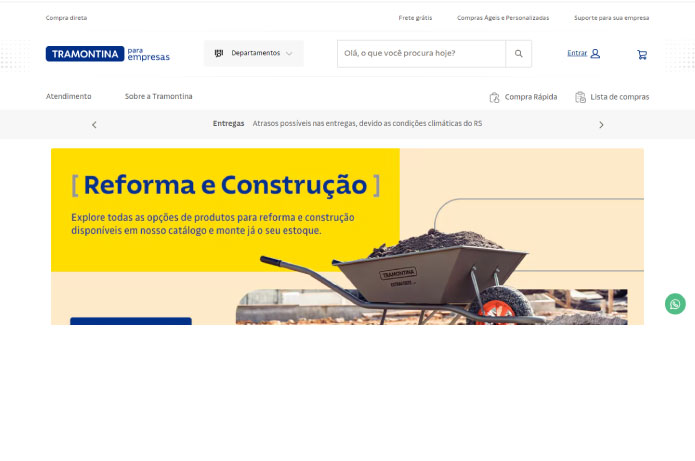
Tramontina, the renowned Brazilian company of utensils and tools, announced the launch of its exclusive e-commerce platform for B2B (business-to-business) sales and for use and consumption. This initiative marks an important digital expansion for the brand, complementing traditional service through representatives and offering a new way to interact with business clients.

The new online channel, available at empresas.tramontina.com.br, allows customers to access the company’s vast portfolio, which includes over 22,000 items. The product range covers everything from household utensils and tools to furniture, catering also to the hospitality and food service sectors, including restaurants, bars, cafés, and hotels, as well as retailers, wholesalers, and resellers.

Among the main benefits of the platform are:

  1. Quick and personalised shopping
  2. Complete order management, including those made online and by representatives
  3. Specialised support tailored to the specific needs of each customer
  4. Free shipping for orders that meet the minimum purchase requirement

This initiative by Tramontina represents a significant step in the digitalisation of its sales processes, aiming for closer engagement with the brand and facilitating business management for its corporate clients. The company hopes that this new B2B sales channel will enhance its market reach and provide a more efficient and convenient shopping experience for its corporate customers.

Anatel publishes list of e-commerce sites with advertisements for illegal mobile phones; Amazon and Mercado Livre top the ranking

The National Telecommunications Agency (Anatel) revealed last Friday (21) the results of an inspection carried out on e-commerce sites, focusing on advertisements for uncertified mobile phones or those that entered the country unlawfully. The action is part of a new precautionary measure published by the agency to combat piracy.

According to the report, Amazon and Mercado Livre had the worst statistics. At Amazon, 51.52% of mobile phone listings were for non-compliant products, while at Mercado Livre this number reached 42.86%. Both companies were classified as “non-compliant” and must remove the irregular listings, under penalty of fines and possible removal of their sites.

Other companies, such as Lojas Americanas (22.86%) and Grupo Casas Bahia (7.79%), were deemed “partially compliant” and will also need to make adjustments. On the other hand, Magazine Luiza reported no illegal listings and was classified as “compliant”. Shopee and Carrefour, although no percentages were disclosed, were listed as “compliant” due to their prior commitments to Anatel.

The president of Anatel, Carlos Baigorri, highlighted that negotiations with e-commerce companies have been ongoing for about four years. He specifically criticized Amazon and Mercado Livre for not engaging in the collaborative process.

The inspection took place between June 1 and 7, using a scanning tool with 95% accuracy. Anatel reported that, after focusing on mobile phones, the agency will investigate other products sold illegally without certification.

The precautionary measure published today aims to give companies another opportunity to comply with the regulations, starting with mobile phones. Anatel stressed that other companies, beyond the seven major retailers mentioned, are also subject to the same requirements.

Magazine Luiza and AliExpress announce unprecedented partnership in e-commerce

Magazine Luiza and AliExpress have entered into a historic agreement that will allow for the cross-selling of products on their respective e-commerce platforms. This partnership marks the first time that the Chinese marketplace will make its products available for sale by a foreign company, in an unprecedented cross-border strategy.

The collaboration aims to diversify the catalogues of both companies, leveraging each other’s strengths. While AliExpress is known for its variety in beauty items and tech accessories, Magazine Luiza has a strong presence in the home appliances and electronics market.

With this initiative, the two platforms, which together account for over 700 million monthly visits and 60 million active customers, expect to significantly increase their sales conversion rates. The companies assure that there will be no changes to tax policies for consumers and that the guidelines of the Remessa Conforme program will be maintained, including the exemption of fees for purchases under US$ 50.

The announcement of the partnership was well received by the financial market, resulting in a more than 10% increase in Magazine Luiza’s stock, which had been facing a nearly 50% decline this year.

This collaboration represents an important milestone in the Brazilian and international e-commerce landscape, promising to expand shopping options for consumers and strengthen the position of both companies in the market.

Deliveries and prices: how to retain customers in e-commerce?

Philip Kotler, in his book “Marketing Management,” states that acquiring a new customer costs five to seven times more than retaining existing ones. After all, for the repeat customer, it is not necessary to invest effort in marketing to present the brand and gain trust. This consumer already knows the company, the service, and the products.

In the online environment, this task is more strategic due to the lack of face to face experience. Building customer loyalty in e-commerce requires specific actions to satisfy the consumer, strengthen the relationship, and encourage them to purchase more often.

This finding may seem obvious, but it is only possible to retain buyers who are satisfied with the experience they had. If they are dissatisfied due to an error in the payment process or delayed delivery, for example, they may not return and might even speak negatively about the brand.

On the other hand, loyalty is also advantageous for the consumer. Upon discovering a reliable e-commerce platform, with quality products and fair prices, good service, and timely deliveries, they do not expend energy searching elsewhere and start to see that store as a reference. This generates trust and credibility that the company provides the best service.

In this scenario, two elements prove fundamental to ensure the loyalty process: deliveries and prices. It is interesting to know some essential strategies to strengthen these operations, especially in the virtual environment:

1) Investment in last mile 

The final phase of delivery to the consumer is one of the keys to ensuring a good experience. In a company with national reach, for example, it is crucial to establish partnerships with local organizations that can handle deliveries in a more personalized manner. Additionally, one tip is to offer exchanges and training for regional delivery personnel so that the order arrives in perfect condition and represents the brand well. Ultimately, this strategy also reduces costs and shipping fees for the consumer, addressing one of the main pain points in today’s online sales market.

2) Packaging

The moment of packaging the product is important. Treating each delivery as unique, taking into account the packaging needs and peculiarities of each item, is essential to ensure proper handling. Furthermore, personalizing deliveries with unique touches makes a difference, such as handwritten cards, spritzes of perfume, and sending gifts.

3) Omnichannel

Having data tools and careful, in-depth analysis is fundamental in a venture to enhance this experience for the consumer. The benefits are numerous. Firstly, there is more assertive communication and smarter strategies when we implement omnichannel, as the user enjoys a unified experience online and offline. The service becomes even more personalized and precise.

4) Marketplace

Entering a broader offering environment allows for varied purchasing options. This way, it is possible to meet the diverse needs of the audience, bringing alternatives for all tastes and styles. Today, the tool has become indispensable for e-commerce. It is necessary to offer diverse options, with effective solutions for audience demands, as well as focusing on different offers with low price options.

5) Inclusion

Finally, thinking about inclusive platforms enables democratic service and reaches an even larger audience. Offering purchases via telephone or WhatsApp, as well as providing personalized service through customer care, are alternatives that are widely used today.