

Início Site Page 2

70% of digital transformations fail and the problem is rarely software 

Data consolidated in April 2026 by TI Inside and corroborated by McKinsey indicate that 70% of digital transformation initiatives in companies fail.For Virgilio Marques dos Santos, PhD in Engineering from Unicamp and founding partner of FM2S Education and Consulting, the problem is not necessarily in the technology adopted, but in the way organizations lead the change.

According to the expert, there are three recurring illusions that lead to the collapse of these projects: the belief that technology replaces process strategy, the misalignment between incentives and operation, and the use of digital transformation as a symbol of modernization, without real structural changes. 

The first illusion is to believe that implementing technology is equivalent to transforming processes. “The most common mistake of leadership is to superimpose modern systems on dysfunctional and highly bureaucratic organizational structures.In this scenario, the company only creates an electronic bureaucracy. Automating an inefficiency does not solve the problem; it only increases the speed with which waste happens”, says Santos. 

Institutional redesign needs to come before technological implementation. Without reviewing flows, responsibilities and operational bottlenecks, digitalization tends only to sophisticated old problems.

McKinsey data shows that companies that actively engage employees during the change process are up to eight times more likely to succeed. Still, many organizations implement new tools without reviewing metrics, goals, or forms of evaluation.

“Leadership imposes a new tool from top to bottom, completely changes the routine of those who operate value generation, but maintains the same charges and indicators of the previous model.The worker perceives operational risk and creates parallel mechanisms to ensure the delivery”, he explains.

According to Santos, it is in this context that the so-called“hidden spreadsheets and informal controls arise, which coexist with official corporate systems.”O the system fails because incentives remain misaligned. Technology changes, but organizational logic remains the same“, he points out.

The third illusion, according to the manager, is deeper and involves the corporate culture itself.“Transforming a company requires facing internal conflicts, dismantling power fiefdoms, admitting vulnerabilities and going through a temporary period of lost productivity.

In this scenario, the acquisition of great technological solutions can work as a kind of symbolic shortcut. “Signing a millionaire contract with a big tech generates the immediate sense of modernization. The purchase of technology becomes a comfortable alibi to avoid the wear and tear of the management of the CHANGE”, he says.

In Santos“ assessment, digital transformation only produces sustainable results when it is treated as a broad organizational change ¡ ̄ and not just as a technological update.”The illusion of transformation is bought so as not to have to pay the price of the real effort”, he states. Without alignment between culture, operation and strategy, digitalization risks only expanding existing inefficiencies under an appearance of modernization


E-commerce: conversion can grow up to 5x with integration between data, operation and service 

Between click and delivery of e-commerce, a chain of simultaneous and integrated decisions supports each order and there is no room for failure. Applications analyzed by Quality Digital indicate that integration between different fronts of the journey can boost results, with cases such as Osklen, which record growth of up to five times in the conversion of order recovery into conversational channels by connecting data, service and execution throughout the process. Each order runs a continuous sequence of decisions executed simultaneously so that the journey works consistently.

Inspired by the logic of transport networks, the digital operation of Quality Digital organizes e-commerce as a structure in which different flows operate in a parallel and interdependent manner. B2C, B2B, D2C, marketplace and omnichannel appear as lines that intersect along the journey and connect to critical points that support the execution. Decisions related to catalog, price, availability, payment, order management, logistics and delivery cease to act in isolation and begin to compose an integrated network, in which performance depends on the consistency between data and systems. 

The proposal defended displaces the traditional reading of digital commerce, which for a long time was organized sequentially. By positioning the request as a central element, the model shows that the continuity of the journey depends on the coordination between multiple layers that operate at the same time. “A sale is no longer an isolated event and has become data-driven throughout the operation. When this base is organized, it is possible to measure direct impact on conversion, average ticket and” recurrence, says Julio Britto, CEO of Quality Digital.  

The expansion of channels and integrations has raised the level of operational complexity in companies. Commerce platforms, order management systems, payment methods, logistics solutions and customer relationship tools have started to act simultaneously, requiring continuous synchronization. With the reduction of manual intervention, response time decreases, while inconsistencies tend to spread with greater speed throughout the operation. 

E-commerce performance is increasingly associated with the ability to execute. Demand generation loses relevance when the operational structure does not sustain the journey to delivery.Inaccurate information at checkout, inventory divergences and logistic misalignments affect the consumer experience, increase costs and impact the perception of brand value. 

According to Roberto Ave Faria, director of Quality Digital, the execution of the journey needs to combine operational precision with the ability to adapt to demand.“The concept of delivery promise works as a delivery deadline contract and is decisive for the finalization of the purchase, after all, any deviation directly impacts the conversion and consumer confidence”, he says. The executive also highlights the need for evolution in the way retail works the hyperpersonalization of the experience. “In the concept of home for you, the digital showcase starts to be assembled according to the profile, history and customer interest. 

Currently, in the digital commerce scenario, the sustainable growth of e-commerce depends less on the increase in volume and more on the ability to coordinate decisions in an integrated way. With the expansion of digital channels and the increase in the connections necessary to support each order, operational efficiency begins to define the limit between growth with profitability and loss of performance. By making this structure visible, the model presented contributes to a more accurate understanding of the factors that determine the result in digital commerce.

Brazilian retail grows 1.2% in the first three months of 2026, says Mastercard SpendingPulse

The first quarter of 2026 saw growth in Brazilian retail. According to Mastercard SpendingPulse, which measures retail sales in physical and online stores representing all payment types, the industry recorded average growth of 1.2% in the 1st quarter of this year compared to the same period in 2025.

In all, 10 sectors of the economy were analyzed, seven of them with performance above the national average. “The result of the 1st quarter reinforces the resilience of the Brazilian consumer, especially the restaurant sector, which presented strong dynamism.The Midwest region continues as a positive highlight, while we observe growth opportunities in sectors such as furniture and decoration, for example.”, says Gustavo Arruda, Chief Economist for Latin America at the Mastercard Economics Institute (MEI).

Sectors that have grown the most

In the performance by sectors, some went from 6% and even reached the double-digit level. The main positive highlights were Restaurants (10,1%), Pharmacies (9,6%), Hosting (6,5%). In contrast, others showed more restrained performance, such as Supermarkets (-1,5%) and Furniture and decoration (-4,4%), for example.

Performance by region

In the regional cut, 11 of the 27 federative units outperformed the average growth of the country, indicating a heterogeneous consumption pace between the different regions.

All regions had positive results.The Midwest led growth with 2.5%, while the Southeast recorded the lowest advance (0.1%). The two states with the best performance were Pernambuco (5.4%) and Parana (4.1%), with the Federal District then advancing 4%.

ifood announces national campaign for deliverymen with bag and official CBF items, additional earnings and experiences

IFood, a Brazilian technology company, announces a special program aimed at deliverymen throughout Brazil during the biggest football event of the year. With the concept “O game starts on the street”, the campaign connects the daily lives of those who work on the streets daily to the way Brazilians live football in cities, bringing together exclusive clothing distribution, promotional campaigns, experiences linked to the tournament and activations at the platform's support points.

Among the highlights are bags, UV T-shirts, jackets and official CBF hoodies that will be distributed throughout the months of May and June in 12 Brazilian cities: Sao Paulo, Rio de Janeiro, Santos, Belo Horizonte, Recife, Salvador, Curitiba, Brasilia, Goiania, Fortaleza, Porto Alegre and Campinas. Information on invitations, challenges and distribution of items will be communicated directly by the application of the deliverymen.

The distribution will be aimed at deliverymen invited by the platform, with priority for the category Super IO who are the deliverymen with the best performance of the platform, but will also feature actions for deliverymen of the regular basis.

The program also includes campaigns with additional earning opportunities, such as the “Time mechanics on the” track, which allows a deliveryman to assemble his team of deliverymen and win up to R$5 thousand additional for these nominations, and other raffle campaigns, as well as experiences connected to the tournament climate. Among them are the participation of deliverymen in the farewell game of the Brazilian national team at Maracana, actions in the iFood Shirt 10 Arenas in Sao Paulo and Rio de Janeiro, participation of deliverymen in the farewell carriage of the Brazilian national team, events of changing stickers and distribution of exclusive items, including autographed jerseys by the national team.

In the coming months, the more than 41 iFood support points distributed throughout Brazil also enter the competition climate.In different regions of the country, deliverymen will be able to participate in actions with thematic setting, distribution of gifts, award-winning turn and living areas. The program provides activations in cities in the Northeast, Southeast, Midwest, South and North regions of the country.

The campaign also includes cultural actions inspired by the way football is lived on the streets of Brazil, with street painting initiatives and experiences connected to the daily life of cities during the tournament period, iFood will be with Rocinha deliverymen and influencer Ruan Juliet in an action that will reform a court in the community that will be used for a tournament of local deliverymen.

In addition to face-to-face programming, iFood prepares an unprecedented experience within the deliveryman's application. During the campaign period, the app will have a thematic visual identity, special content and a central dedicated to the activations and experiences of the platform. The space will gather challenges, information about the programming and news in one place.

“When the Brazilian football team enters the field, it transforms the routine of the cities, moves the streets and creates moments of encounter that are part of the Brazilian culture. As the deliverymen are on the streets all the time, and live this daily life, we think of a program that would bring them even closer to this experience throughout the tournament. The idea of the campaign is precisely to connect the football climate with those who are on the streets daily, creating opportunities for recognition, coexistence, entertainment and special experiences during this period”, says Beatriz Pentagna, director of B2B marketing at iFood.

With a program that combines recognition, entertainment and earning opportunities, iFood reinforces its commitment to valuing deliverymen throughout the country.For more information about the schedule, deliverymen can follow the official channels of the platform.

Automation advances in logistics, but structural failures still hamper operational efficiency

Investment in logistics automation has been growing rapidly in Brazil and worldwide, driven by the need to gain efficiency and, at the same time, by increased operational complexity, pressure to reduce costs and increasing difficulty in hiring and retaining labor.In distribution centers, logistics hubs and intralogistics operations, the need to process more volume, with more speed and fewer errors, has placed technology at the center of operational strategy.

However, although investment in automation advances, many companies still face difficulties to transform technology into real efficiency. Problems such as flow management failures, low standardization of processes, excessive manual steps and lack of integration between systems continue to limit the expected gains.

According to Fortune Business Insights projections, the global logistics robotics market is expected to grow by about 13.9% per year by 2030. Already a Deloitte survey points out that more than 75% of companies already adopt some level of intralogistic automation. Despite this, the adoption of new technologies is not always accompanied by a structural review of the operation.

In practice, the scenario reveals a mismatch between investment and execution. Many organizations direct resources to advanced technologies, such as robots and automated systems, without first solving structural and basic issues of the operation, such as process organization, layout design, flow organization and, especially, data visibility and integration between logistics steps.

This challenge becomes even more critical in the face of labor shortages.With leaner teams and greater difficulty to fill operational positions, automation is no longer just an alternative to gain productivity and becomes a tool to support the continuity of the operation.

“There is a tendency to look at automation as an immediate solution, especially when the company is already pressured by volume, cost or lack of manpower.The challenge, as many think, is not only in the application of technology, but in the ability to implement it consistently so that it is scalable and aligned with the reality of the” operation, says Murilo Namura, Head of Equipment at Pitney Bowes, a global company that provides technology, logistics and services worldwide.

According to the executive, one of the main errors is in the timing of the investment. Many companies only seek more robust solutions when the operation already has relevant bottlenecks, such as delays, rework, low productivity, accumulation of orders or difficulty absorbing demand peaks. In these cases, the implementation can become more complex, costly and sensitive to the operational routine.

“When automation is thought of reactively, it needs to solve problems that could have been avoided with planning. Therefore, before investing in technology, it is essential to map processes, understand bottlenecks, assess the dependence on manual tasks and identify where automation can really generate” impact, adds Namura.

Deloitte says organizations that implement automation reactively after disorganized growth can experience up to 30% higher costs, as well as face increased adaptation time and increased risk of disruption during the transition.

For Pitney Bowes, logistics automation should be seen as part of a structured operational efficiency strategy, not as an emergency response. This includes not only the adoption of equipment and systems, but also the redesign of internal flows, integration between logistics steps, use of data for decision making and preparation of the operation to gain scale.

“The difference is not in isolated technology, but in the ability to transform this investment into real efficiency in everyday life. Companies that can do this in an integrated and continuous way are the ones that need to process more volume, with fewer people and greater control intelligently and with the lowest possible ROI”, concludes the spokesperson.

Millennials in the crosshairs of fraud: almost 600 thousand profiles were targeted by e-commerce scams in 2025, says Serasa Experian

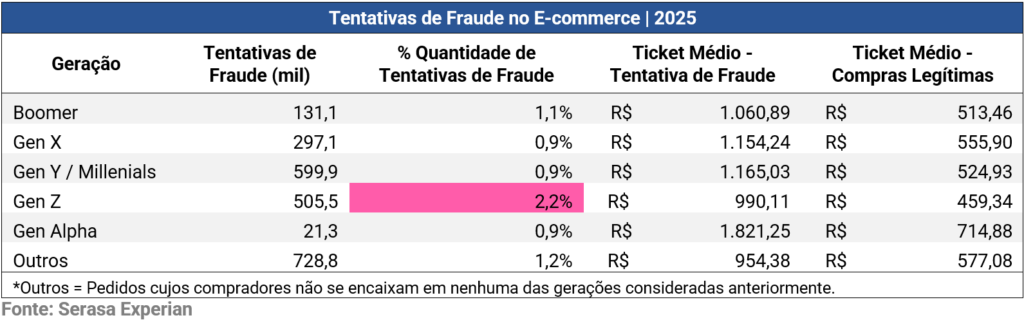
Millennial profiles were the most used in attempts at fraud in e-commerce throughout 2025, with 599.9 thousand occurrences associated with generation Serasa Experian, first and largest datatech in Brazil, which also shows a clear pattern in the choice of targets simulated by scammers: the top 3 of the ranking is formed by groups known for their presence in the digital environment and already established financial life, also bringing together Gen Z, with 505.5 thousand diligences, and Generation X, with 297.1 thousand.

“When we look at e-commerce in depth, we realize that fraudsters do not act randomly: they seek profiles that make sense within the dynamics of each channel, category and means of payment. Understanding which consumers are most imitated in these attacks is essential to better calibrate prevention models and protect the operation without compromising the customer experience”, says Director of Authentication and Fraud Prevention, Rodrigo Sanchez.

Although generation Y leads in absolute volume, proportional reading changes the ranking. Gen Z presented the highest risk rate among the groups analyzed (2,2%). Rodrigo explains that at first glance, the percentage may seem low, but it represents the share of orders in which there was a suspicion of fraud within that group. The finding means that the fraudulent pressure on Gen Z was the most intense of the cutout. Among the named generations, the Boomers appear in the sequence, with 1,1%. It also draws attention to the category “Other”, which gathers outside the groups, Z, more graphic rate of Y, more detailed 1, more graphic, more than Boomers 1, more risk than Boomers 2.

In the average ticket cutout, almost all generations recorded average value of attempted fraud above R$ 1 thousand. The exception was Gen Z, with R$ 990.11. At the other end, the Alpha generation had the highest average ticket fraud, R$ 1,821.15, 56.3% above the recorded in the attempts associated with millennials, which appear soon after, with R$ 1,165.The data indicates that when criminals try to reproduce the behavior of this generation also 4, they are more robust.

Methodology

The survey considers the requests analyzed by the Serasa Experian fraud risk models between January 1 and December 31, 2025, in the e-commerce, marketplace, direct sale and app delivery channels, consolidated on a single basis. In the study, “ fraud attempts correspond to orders classified as suspected fraud, confirmed fraud or with chargeback (CBK). For generational segmentation purposes, buyers were grouped into the following age groups: Alpha generation, up to 15 years; GENERATION Z, from 16 to 3 years, from 4 to 30 years, Generation of 4 years; Generation Yout to 1.

Americanas records growth of 7.8% in Same Store Sales in the first four months of the year

Americanas today released its results for the first quarter of 2026 (1Q26), reaffirming its trajectory of structural transformation and operational efficiency.With a strategy focused on the profitability of physical stores and the acceleration of the O2O (Online-to-Offline) model, the company presented significant advances on all its business fronts, reporting a 20% growth in consolidated Gross Revenue over the same period a year earlier.

“The results consolidate the consistency of our strategy, focusing on physical retail and a repositioned digital, working the assets we already have: our team, stores and consumers”, says Fernando Soares, CEO of Americanas.

Reference in the Easter event in retail, Americanas highlights the vision of the quarter for comparability purposes due to the partial sale of the event (40%) having occurred in March. In the period, performance was led by the physical retail and O2O segment. The Same Stores Sales Indicator (Same Store Sale or SSS) showed a jump of 7.8% in the first four months of the year (4M26), driven by the success of major seasonal events such as Easter, which reached a new record of R$ 1.1 billion in sales, up 10% from 2025, and the Back to School campaign, with SSS growth of 8.8%. Sales per square meter increased 11.2% in 4M26, reflecting the strategy of operational optimization and evolution of the in-store experience.

Digital advances and Services grows 19% in first quarter

The new digital design reinforced the complementary role of the channel in the physical store experience and consolidated O2O as the main growth vector in the first quarter. The delivery model from physical stores recorded a 56% advance of Gross Revenue in 1Q26. The greater integration between online and offline has allowed the volume of orders placed by the Americanas website and app and by partner delivery platforms to practically double, taking advantage of the capillarity of the 1,448 physical stores. “A strong loss reduction in the channel follows an operational improvement agenda that has been going on since last year and is a result of the sale, expense control and intense execution of the strategic PLAN”, comments the executive.

As part of the journey of evolution of the customer experience, the services and loyalty front presented robust indicators, with the program “Cliente a” reaching the mark of almost 1 million participants. These customers demonstrate a superior engagement, with average spending 3.1 times higher than the others. Already in the financial aspect, the credit card surpassed R$ 1.0 billion in total volume of payments (TPV) accumulated, while the services front registered growth of 19% in 1Q26, with a record conversion into extended guarantees.

Efficiency gains and cost reductions

Operating developments are also reflected in financial discipline and cost control.Americanas recorded a 4.3 percentage point reduction in sales, general and administrative expenses (SG&A) as a percentage of Net Revenue. This efficiency gain, coupled with commercial performance, allowed the company to evolve in Adjusted EBITDA in ex-IFRS 16¹ criterion, which ended the first quarter in negative R$ 186 million, which resulted in a, a significant improvement of R$ 56 million over 1Q25.
“This transformation comes from a great financial discipline and the better understanding and care of our 40 million active” clients, says Fernando Soares.

(1) Adjusted EBITDA ex-IFRS 16 excludes RJ expenses and research, asset write-downs, haircuts arising from PRJ approval and effects of self-regulatory taxes, and includes rent payments.

Luciano Hang calls for tax equality after announcement of the end of the “taxa das blusinhas”

The businessman Luciano Hang, owner of Havan, once again defended equality in the treatment given to Brazilian companies after the announcement of the possible end of the so-called “axa of the” blouses.For him, if the government intends to withdraw taxes on imported products of up to 50 dollars, the same measure should apply to domestic products in the same value range.

“I am in favor of reducing taxes, but that this happens equally for everyone. If you are going to take the tax from the entry of foreign products of up to 50 dollars in Brazil, then take it equally from Brazilian products. You can not relieve for those who come from outside and continue suffocating those who produce, employ and pay taxes in the country”.

According to Luciano, retail and domestic industry face unequal competition, while Brazilian companies continue to be subject to high tax burdens and strict supervision.

“In Brazil more than one million international packages come every day without the same control required of national companies. Where are Inmetro and Anvisa in this inspection?There is a huge rigor against those who produce in Brazil, while foreign products enter without any inspection”.

For the entrepreneur, the situation poses a risk not only to the economy, but also to public health.

“Products that enter without control can bring risks to the population. We need to defend the national industry, Brazilian retail and, especially, the” jobs.

Luciano also commented on the repercussion involving the company Ype and said that the case highlights the unequal treatment faced by national companies.

“O what happened to Ype is a clear example of what many Brazilian companies face. While domestic companies are exposed and attacked publicly, foreign products enter the country with virtually no collection or CONTROL”.

The businessman also said that he does not encourage the consumption of products suspended by the competent bodies, but understands that situations like this end up being used to promote political attacks against national companies and public people.

“That is why I speak out in defense of Brazilian companies, national industry and tax equality”.

For Luciano Hang, the debate needs to be conducted responsibly and without politicization.

“Unfortunately, we see yet another attempt at politicization and persecution against businessmen and public people who only speak out in defense of a national company”.

Freight does not track cost and carriers operate at the limit in 2026

Road freight transport entered 2026 with a difficult account to close. On the one hand, operating costs continue to rise. On the other, the ability to pass these increases to freight remains limited by a still cautious market, pressured by interest, irregular consumption and tight margins in industry, retail and agribusiness.

Diesel, the main input in the sector, represents on average 35% of the operating cost of Brazilian carriers, according to NTC & Logistics. Therefore, any oscillation in fuel has an almost immediate impact on the freight price and profitability of transport companies.

In March 2026, the cost of road freight registered a high of 3,36%, coming to R$ 7.99 per kilometer driven, according to the Edenred Repom Road Freight Index. In the same period, ANTT updated the table of the minimum freight floor due to the high of diesel, raising the displacement coefficient of R$ 5.986/km for R$ 6.368/km.

For Celio Martins, new business manager at Transvias, the problem is not only in the high costs, but in the speed with which they reach the carrier.

“The transport feels everything very fast.When diesel goes up, when credit becomes expensive, when consumption slows down, the carrier feels before many people. The problem is that it can not always pass on this cost at the same speed. The margin is being eroded gradually”, he says.

The recent global energy crisis, brought on by the war in Iran and the rise of oil, has brought it close to US$ 110 per barrel, led Latin American countries to adopt measures to reduce the impact on fuels. In Brazil, the government announced support for diesel, gas and the air sector, as well as reducing taxes on biodiesel and cooking gas, according to El Pais.

In practice, even when there is an attempt to cushion the impact for the consumer, the productive sector remains exposed to volatility. Trucks depend on diesel, parts, tires, maintenance, insurance, labor and financing. When these items rise at the same time, the operation becomes heavier.

The difficulty also appears in the renewal of the fleet.Data published by Transporte Moderno show that truck sales accumulated a fall greater than 15% in the first quarter of 2026, reflecting adverse environment for road transport, marked by high interest rates, diesel cost and greater caution in investments.

“When truck sales fall, this shows that the sector is postponing investment.Many companies continue to operate, but with an aging fleet, more expensive maintenance and less ability to modernize the” operation, Martins analyzes.

Another point of attention is in the infrastructure. Survey of the CNT points out that poor conditions of highways increase the operating cost of carriers. In 2025, this scenario would have generated additional consumption of 1.2 Billion liters of diesel, with direct impact on the cost of the sector.

For shippers, the risk is to treat freight only as a cost line to be compressed. According to Martins, this view can generate reverse effect.

“When the freight gets artificially low, someone pays this bill.It may be the carrier, with negative margin.It may be the shipper, with delay and loss of quality.It may be the consumer, with higher price up front. The freight needs to be negotiated intelligently, not only by the lowest value”, he says.

It is in this context that data and planning gain relevance. Transvias tracks the movement of freight queries in different regions and cargo profiles, which allows you to observe changes in behavior before they appear in official indicators.

“In our base, we can see when a sector begins to reduce consultation, when a region loses strength or when the search for freight alternatives increases. This type of reading helps shippers and carriers to make better” decisions, says Martins.

Transvias has seen an increase in 21,95% in the total volume of freight queries compared to the previous year. This growth indicates that, in the face of high costs, shippers are intensifying the quotation and the search for new partners to optimize budgets. 

The platform data shows that the sector of E-commerce and Consumer Goods leads the rise in demand for transport, with an advance of 12%. In contrast, the sector of Civil Construction it presented the largest retraction, with a drop of 8% in the consultations for large volume freight and heavy loads. 

We observe a clear change in behavior: the search for fractional loading and redispatching grew 18% in recent months, this signals that companies are avoiding to stock up on large volumes and preferring smaller, more frequent shipments to preserve cash flow. 

For 2026, the trend is for a more selective market.Carriers will have to better control costs, choose healthier operations and avoid freight that does not cover the minimum structure of the operation.Shipmen, in turn, will need to understand that logistics efficiency depends not only on price, but on predictability, partnership and planning.

“Road transport is one of the first sectors to feel the real economy.If it is under pressure, it is a sign that the entire chain needs to pay attention”, summarizes Martins.

Automation tools in WhatsApp enter the sales routine of Brazilian companies

The use of WhatsApp as a service and sales channel is already part of the routine of companies and autonomous entrepreneurs in Brazil. What was once a practical alternative for direct communication with customers now evolves into a more strategic role, becoming part of the commercial automation infrastructure of organizations. The use of technology improves the functioning of teams and optimizes the work of salespeople.However, with the increase in the volume of interactions, challenges arise related to the organization of conversations, the control of negotiations and the preservation of relevant data.

In this context, solutions that connect WhatsApp to customer relationship management systems gain space, allowing companies to transform conversations into structured and actionable information.For Tulio Monte Azul, co-founder and product director of Agendor, a company responsible for an ecosystem of solutions aimed at sales and CRM management, keeping conversations only on WhatsApp, without integration with management systems, can bring important risks to the business.

''You may lose critical data, ignore relevant demands or simply fail to access essential information at the time of the proposal or after-sales ' he says.

By structuring and storing conversation data, sales teams now have more complete information to customize approaches and resume contacts with leads more efficiently.

''Negotiate intelligently is to use the data that the customer himself provided. And, for this, the CRM needs to be complete and up to date, without relying on manual searches or individual memory ' says the expert.

Integration increases efficiency of teams

To put into practice the connection between WhatsApp and CRM, Agendor Chat, developed by Agendor, brings the messaging application closer to the automation tool, creating a bridge between customer contact and business management.

The tool has automation features that allow you to distribute conversations between salespeople, send predefined message templates and qualify leads for CRM semi-automatically. This type of organization contributes to increase the efficiency of teams and reduce failures in the service process. Another highlight of the solution is the centralized recording of interactions, which ensures greater security for companies in situations such as team changes, loss of access to numbers or lack of formalization of negotiations in other channels.

The evolution of this scenario points to an increasingly advanced integration between WhatsApp and CRM, driven by the use of artificial intelligence. For the next few years, according to Tulio, the expectation is that the tools are able to automatically interpret conversations and perform actions within management systems, reducing operational tasks and expanding the focus of teams on sales activities.

''We are moving towards a scenario where AI interprets the exchanged content and automatically performs actions in the CRM, reducing operational work and freeing up time for the seller to focus on what matters: selling 'DOU explains.

WhatsApp has the highest engagement rate of the service

According to data from Pluga, a Brazilian platform that connects, without the need for code, the main management tools used by small and medium-sized companies, the group of users who use WhatsApp has the highest engagement rate of the company's service.

The company's numbers show that the volume of events in WhatsApp is about 12 times higher than average, while active automations are 16 times higher than the rest of the base, accumulating more than 500 thousand messages triggered in just two years. Among the companies pioneering this use, marketing and advertising agencies stand out as one of the sectors that most use this type of application.

Also according to data from Pluga, WhatsApp is the main communication channel in Brazil, but few companies take advantage of this channel in the best way. The survey of the company points out that brands already live within the flow where the messaging application is the natural destination of leads that capture and qualify for their customers.

For Diego Minone, CMO of Pluga, automating the path is an operational decision. And it is at this layer that something bigger is happening: WhatsApp is no longer a service tool and becoming part of the infrastructure of commercial operations.

The agencies arrived first because they already live within this flow: capture the lead, qualify and deliver through the right channel. WhatsApp is the right channel in Brazil. What the data show is that automating this last mile is still rare, but who does it operates at another level. The trend is that this is no longer an exception.

Major errors in tool integration

When using the integration tools between CRM and WhatsApp, it is necessary to take some care. According to Gustavo Gomes, sales specialist at Agendor, the main mistakes made by companies in this topic involve disorganization, lack of personalization in service and excessive sending of automatic messages without any strategy. In addition, when there is no well-defined process, customers are unresponsive, which generates significant delays in service and, consequently, loss of business opportunities.

For this channel to work in a sustainable way, it is essential to structure a sales funnel specific to WhatsApp, segmenting contacts according to the degree of maturity of the lead. The proposal involves having an updated database, with organized information, which avoids wasted efforts with inadequate profiles and allows you to trigger the right action, at the right time, for the right customer.

Finally, Gustavo also says it is essential to standardize care and establish well-defined flows.

''The team needs to be trained to maintain a professional and consultative tone, with clear and objective messages. It is equally important to set deadlines for response and use automations strategically, always preserving the human touch 'D.

More than capturing data, the new generation of CRMs needs to interpret the business context and act on it.

^^^^Not only software, but a new management model, where technology ceases to be support and starts to act as co-pilot of sales teams.