


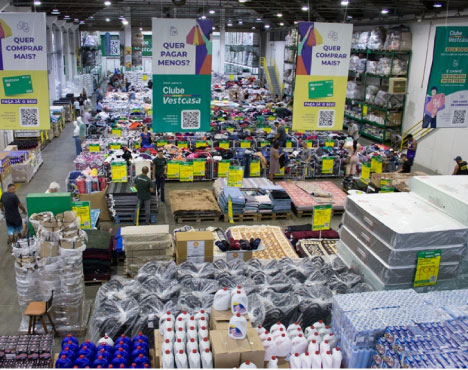
For the third year in a row, Vestcasa won the brand award most admired by consumers in the Home Goods segment of the Ibevar 2024 ranking.The award, which will be officially delivered in August, analyzes 120 national retail companies, which represent almost 30% of the consumption of goods in the country, disregarding vehicles.
In addition to practicing truly low prices, one of the secrets of Vestcasa's success is its socio-environmental responsibility. According to the Retail 2024 report, from the payment technology company Adyen, Brazil is the second country most concerned with the social and environmental commitment of retailers, a response presented by 46% of consumers. According to the study, most Brazilians (56%) would pay more in a product if the seller was transparent about the measures used to reduce the impact on the environment.
In the case of Vestcasa, in addition to the company fulfilling its role for the sustainability of the planet, the consumer still pays less, showing that the award received again from the Ibevar Ranking is not the result of chance. “We are very happy with this recognition”, celebrates Ahmad Yassin, founder and CEO of Vestcasa. “O presence as the most admired company in the segment for the third consecutive year shows that we are on the right track.”
Green retail (same)
Network focused on the sectors of bed, table, bath, decoration, household appliances, food and beverages, the Vestcasa it seems to have found the ideal formula to achieve all the requirements of green retail. At the same time that, through various initiatives, reduces the disposal of plastics, fabrics and other materials in the environment, manages to generate wealth ¡ billing, jobs etc. ¡ ̄, providing people with lower purchasing power access to items that, sold in other circumstances, would be impossible to buy.
With a business model inspired by the American Costco, whose members of the shopping club pay a fee to have access to a wide variety of items from groceries and electronics to furniture and clothing & with promotional values 3 Vestcasa has created its own shopping club by which it offers truly competitive prices. The priority is brands and top-tier items.“ is not to sell the product at the lowest possible price, explains Yassin. ”.“
Long before the government broke its head to try to cheapen the price of meat, Vestcasa already made the joy of lovers of a good barbecue. With headquarters in Sao Paulo and branches in Minas Gerais, Rio de Janeiro and Santa Catarina, the network offers the kilo of picanha to R$ 29.90 and can of beer to R$ 1 to the members of its shopping club. To be part of the club, which already has more than 1 million members, the consumer pays an annuity of R$ 70, having the right to purchase products with exclusive prices and with a ratio of 70 to 10 T1 discounts.
According to Yassin, one of the secrets of the company is to listen to the voice of its more than 10 million followers, a number that, incidentally, increases at a rate of more than 11 thousand new fans per day on social networks. “We monitor this very, very, very closely: what the consumer is talking about, his satisfaction index, what he wants to” Today, all the company decisions are guided by what the consumer directs to us. Today, we do not need to do great research. It is just listen every day to what this customer is saying.“
Products without packaging
Vestcasa, which was born green & is the official color of the brand since its foundation in 2008 2, maintains a series of initiatives related to sustainability. In order to reduce the environmental impact of its operations, the network has adopted as a practice to market products without plastic packaging or cardboard boxes. Per day, the network sells about 120 thousand sheets, all without packaging. If the consumer wants to take the products in plastic bags, the company sells the bags separately, discouraging the option for the use of plastics by consumers. In total, when selling products without packaging, the company estimates to avoid the 1 thousand tons, per month, the plastic disposal of 1 tons.
The strategy aims to reduce product prices and increase access for customers, in addition to contributing to the reduction of waste. In some cases, the price of packaging may represent 70% of the value of the item.“A packaging does not only impact the visual of the product on the shelf. There is the cost of placing the item inside the packaging, the increase in volume cubage, which directly impacts on the increase in logistics and transportation cost, also leading to a higher cost of storage, without taking into account, cost of the packaging design, packaging components and the packaging production process”, explains Y“Our focus is on generating less waste and increasing access.”
According to him, the biggest challenge for the adoption of the model of sale without packaging is to connect the customer who can have the world understanding of the impact that packaging has on the entire chain.“A such a great impact, so that you simply take the item home, take and throw away the packaging”, analyzes Yassin. “Ao rationalize the purchase, the customer ends up undressing the veil of marketing and looking for the best product, at the best price”.
Sale of refurbished items
In order to reduce the disposal of products in the environment, while offering more attractive prices for customers, Vestcasa bets on the sale of products with defects. Some are reformed. Others, with almost imperceptible flaws, are sold at great discounts.
Clothes such as T-shirts, shorts, dresses and pants with small defects are reformed by an external team and put on sale for cheaper prices 1 dresses that usually cost R$ 239, reformed leave for 39, and T-shirts R$ 150, reformed, are sold to R$ 39.90. With a total of 14 thousand pieces already sold until November 2023, the strategy has already generated to Vestcasa a turnover of R$ 500 thousand, with products that, in theory, would be discarded.
In another front of the commercialization of defective items, products with minimal flaws that would initially be discarded after failing in quality control are sold as is, without reform or repair, at prices well below normal values. Until last November, more than 150 thousand pieces had already been sold in this model, generating a turnover to Vestcasa of R$ 6 million.
Another strategy within the sale of defective products the company rationalizes the defective items sold in kits. Example: if, in a set of six bowls, one unit is broken and, in another set of bowls, two are damaged, the intact units are gathered in a new kit, fully functional and perfect, avoiding the disposal in the environment of entire product kits due to the defects in some of their units. Another example: if a bed set has a bed sheet unpostured and, in another, the part with problem is a pillowcase, the products in good condition are gathered in the same game, also avoiding the disposal in the environment of the kits in one reason of only one of problems in one of its parts.
Recycled raw materials
Several of the products marketed by Vestcasa are produced with recycled raw materials. The fibers used in the manufacture of pillows, duvets and bedspreads are manufactured with plastic from the recycling of PET bottles. Similarly, some models of chairs, tables and organizer boxes are produced with plastic from recycled PET bottles.
Marketing used products
Recently, Vestcasa has partnered with Salim Outlet, which maintains a space within the megalogy of Marginal Pinheiros, in Sao Paulo, where it resells cell phones, notebooks and used and guaranteed technology items. For the retailer, in addition to meeting the demand of consumers for cheaper products and aligned to the idea of circular economy, the initiative becomes a way of attracting to physical stores whose role has been questioned in the face of the new global commercial conjuncture ^ a wider audience. For consumers, the phenomenon provides more advantageous manual buying opportunities with the idea of being a contribution to environmental sustainability.


 Português do Brasil
  English
  Español
  Deutsch
  香港中文
香港中文  Русский
  हिन्दी
  Français
  Italiano
  日本語
日本語  العربية
  繁體中文
繁體中文  বাংলা
বাংলা  Български
  Čeština
  Dansk
Dansk  Ελληνικά
  Suomi
Suomi  Hrvatski
  Magyar
  Bahasa Indonesia
  한국어
한국어  Lietuvių kalba
  Nederlands
  Norsk bokmål
  Polski
  Português de Angola
  Português
  Română
  Slovenčina
  Slovenščina
  Svenska
  ไทย
ไทย  Türkçe
  Українська
  Tiếng Việt
  简体中文
简体中文  Afrikaans
  Íslenska
  Luxembourgish
  Bosanski
  Հայերեն
  Shqip
Shqip  Kiswahili
  فارسی
فارسی  Српски језик
  اردو
اردو  Latviešu valoda
  Català
  Eesti
Eesti  Bahasa Melayu
  English (Australia)
  English (Canada)
  English (UK)
  English (New Zealand)
  English (South Africa)
  Cebuano
  Bashkir
  Acehnese
  Bhojpuri
  Français de Belgique
  ಕನ್ನಡ
ಕನ್ನಡ  Deutsch (Schweiz, Du)
  Deutsch (Österreich)
  كوردی
كوردی  עִבְרִית
  नेपाली
  Беларуская мова
  Quechua