



Fraud in Brazilian e-commerce continued to put pressure on operations in 2025, with 2.3 million attempts recorded Serasa Experian, first and largest datatech in Brazil, and correspond to the digital retail orders that went through the company's anti-fraud solutions.In this monitored universe, the average ticket of fraudulent transactions reached R$ 1,057.87, almost double the amount recorded in legitimate purchases, of R$ 538.79, and about R$ 2.4 billion in losses for companies and consumers were avoided.
“The e-commerce fraud scenario imposes a direct impact on revenue, operational efficiency and consumer experience. When criminal attempts combine high scale, surpassing 2 million diligences last year, and high average ticket, fraud prevention is no longer just a layer of protection and becomes a strategic part of the sustainability of the” business, comments the Director of Authentication and Fraud Prevention, Rodrigo Sanchez.
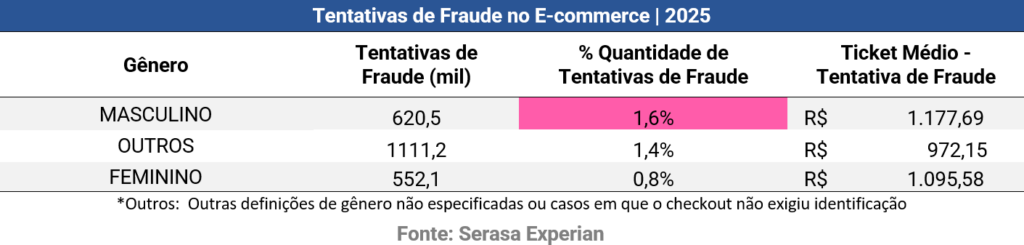
Male profiles concentrate higher risk in the cut by gender
In the cut by gender, the survey also indicates which profiles the scammers try to reproduce in transactions, not necessarily who commits the frauds. Among the requests with identified gender, the male profiles concentrated the highest risk of fraud in the period, with a rate twice higher than that observed among females. The difference also appeared in the value of suspicious transactions: the average ticket of fraud attempts that sought to reproduce male profiles reached R$ 1,177.69, compared to R$ 1,095 when the scammers were passing through female profiles.
For Sanchez, instead of a single protection for the entire base, the trend is for companies to gain efficiency by combining technologies and authentication rules capable of considering the context of each journey, blocking suspicious attacks without generating unnecessary friction for legitimate“ consumers, explains the datatech executive.
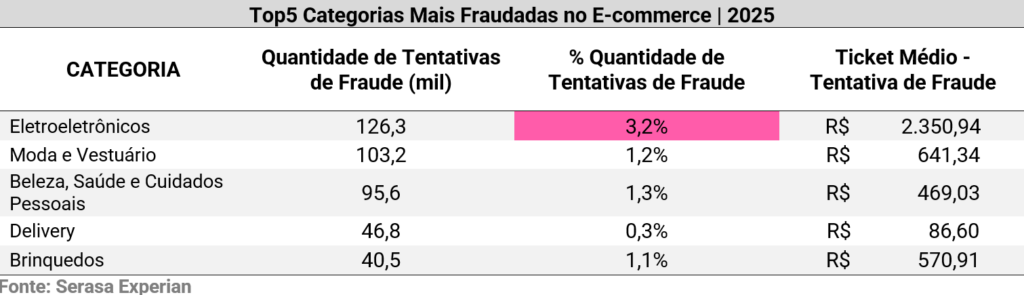
Electronics pull ranking of fraud attempts in digital retail
Among the monitored categories, “Electroelectronics” led in volume of fraud attempts, with 126.3 thousand occurrences barred.After that appear “Moda and CLOTHES”, with 103.2 thousand records, and “Beauty, Health and Personal Care”, with 95.6 thousand.“Delivery” and “Brintoys” complete the top 5, with 46.8 thousand and 40.5 thousand occurrences, respectively.
By observing the proportional risk rate of each segment, “Electroelectronics” also stand out, with 3.2%. In practice, this means that, for every 100 applications analyzed in this category, just over 3 were classified as attempted fraud. The index is much higher than that of the other fronts with the highest incidence, such as “Beauty, Health and Personal Care” (1.31,3TP3T) and “Moda and Clothing” (1.2%).
The average ticket of barred investees follows this scenario. In“Electronics”, the value reached R$ 2,350.94, more than double the overall average of fraudulent transactions in monitored e-commerce, R$ 1,057.87, and was 22.8% above the average ticket of legitimate purchases in the category. Among the most targeted segments, “Moda and CLOTHING” registered average ticket R$ 641.34, while “Brinys15014T.
In higher added value categories, the difference between the ticket of fraud attempts and legitimate purchases is even more evident. In addition to “electronics”, the same behavior was observed in “Houselectrodomestic”, with average ticket of fraud of R$ 2,217.07, compared to R$ 1,551.85 in regular purchases“Automotive” 5, with average of R$ 1,182.22, compared to R$ 64T 64T, although they are also called out of 5, and also called out of the number 5, were considered as well as well as well as well as 6.
“The data show that e-commerce fraud follows the evolution of digital consumption itself, advancing on different product categories.In this scenario, the role of technology is to help companies identify risk patterns more accurately, reduce losses and sustain safer and more fluid buying journeys for the” consumer, concludes Sanchez.
Methodology
The survey considers the requests analyzed by the fraud risk models of the Serasa Experian between January 1 and December 31, 2025, in the e-commerce, marketplace, direct selling and app delivery channels, consolidated on a single basis. In the study,“ fraud attempts are orders classified as suspected fraud, confirmed fraud or with return of chargeback (CBK).


 Português do Brasil
  English
  Español
  Deutsch
  香港中文
香港中文  Русский
  हिन्दी
  Français
  Italiano
  日本語
日本語  العربية
  繁體中文
繁體中文  বাংলা
বাংলা  Български
  Čeština
  Dansk
Dansk  Ελληνικά
  Suomi
Suomi  Hrvatski
  Magyar
  Bahasa Indonesia
  한국어
한국어  Lietuvių kalba
  Nederlands
  Norsk bokmål
  Polski
  Português de Angola
  Português
  Română
  Slovenčina
  Slovenščina
  Svenska
  ไทย
ไทย  Türkçe
  Українська
  Tiếng Việt
  简体中文
简体中文  Afrikaans
  Íslenska
  Luxembourgish
  Bosanski
  Հայերեն
  Shqip
Shqip  Kiswahili
  فارسی
فارسی  Српски језик
  اردو
اردو  Latviešu valoda
  Català
  Eesti
Eesti  Bahasa Melayu
  English (Australia)
  English (Canada)
  English (UK)
  English (New Zealand)
  English (South Africa)
  Cebuano
  Bashkir
  Acehnese
  Bhojpuri
  Français de Belgique
  ಕನ್ನಡ
ಕನ್ನಡ  Deutsch (Schweiz, Du)
  Deutsch (Österreich)
  كوردی
كوردی  עִבְרִית
  नेपाली
  Беларуская мова
  Quechua